
This post begins my Bad Recipes series, an as-yet-unknown number of blog posts calling out bad essential oil practices that I find on the internet. Whoo boy, there are a lot of them. In the process of talking about the bad recipes and why they’re terrible, I’m hoping that I’ll be able to help my readers to understand good practices and safer use of essential oils.
So let’s dive in. As I was searching the internet for inspiration – not for this post, but for development of products for my business – I found a rather extensive post full of recipes for 10 milliliter rollerballs (small bottles with metal or plastic balls in the opening which allow you to apply the oils within directly to your skin, mess-free).

There are several problems with the recipes, including that many of them use prepared blends (so you don’t necessarily know exactly what’s going into your blend) and that the oils she recommends are not from a brand that I trust, but the biggest problem, the one that blew my mind and made me curse out loud, was dilution.
Essential oils are powerful, concentrated plant substances. They all have different chemical compounds in them which give them different therapeutic properties, and which also give them all different safety considerations. Only a very few essential oils are safe to apply directly to your skin undiluted, and some need to be used very carefully indeed in order to prevent such things as allergic reactions, skin irritation, burning, or interactions with medications.
Proper dilution, therefore, is vital to safe use. A general guideline for healthy adults is 2% dilution (10 to 12 drops of essential oil per ounce of carrier oil like jojoba or sweet almond oil) for most issues, and 1% for emotional issues. A qualified aromatherapist may go higher than that for certain conditions, and it’s always good to go lower if it’s appropriate, but that’s a pretty decent baseline. For children under 10, a 1% dilution (5 to 6 drops per ounce) is the highest you want to go, and you don’t want to use essential oils on children under age 2 at all.
Please remember, these are powerful substances and each has its own safety considerations, so it’s better to err on the side of safety and take a “less is more” attitude toward essential oil use.
Now, back to those recipes I found. Rollerball bottles contain only 10 milliliters of oil, which is about a third of an ounce. For an adult, then, based on the dilution guideline I laid out above, you want no more than 3 or 4 drops of essential oil in each rollerball bottle.
These recipes, though. Good grief. These “recipes”. I scanned through them and almost choked.
One of these recipes calls for ninety drops of essential oil. NINETY. In ONE rollerball bottle. That’s absolutely, utterly, completely and in every way UNSAFE.
It’s irresponsible.
It’s wasteful.
It’s nuts.
Seriously, it had me ready to throw my copy of Essential Oil Safety at the writer, but it’s the internet and all I would have accomplished is possibly irreparable damage to my computer screen.
Now wait, you may be saying. Are those oils the ones that you said can be applied neat, or directly to the skin without dilution? ‘Cause you definitely said that some could be.
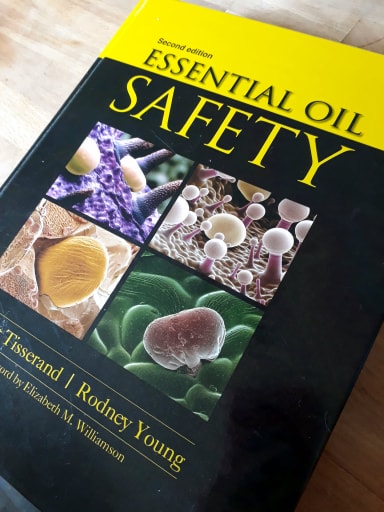
I did say that. And no. No these are not. That particular recipe calls for THIRTY DROPS (my head explodes every time I think of this, for real) of lemongrass oil, which has some significant safety considerations, according to Tisserand (Tisserand and Young, 2014, Essential Oil Safety 2nd Edition) and is recommended not to be used at dilutions higher than 0.7%. That would be 1.4 drops per rollerball bottle.
That’s right. Safe use of that oil would be 1 drop in the bottle, since it’s impossible to take a fraction of a drop and you’d have to round down. This recipe-writer is recommending THIRTY.
And that’s just one example. This page has 25 recipes on it, all of which are diluted at hugely inappropriate levels – by which I mean, they almost aren’t diluted at all.
One calls for 76 drops in the bottle, 18 of which are phototoxic and if worn in the sun could cause severe skin burns.
Another calls for 32 drops, 10 of which are wintergreen, which has similar safety concerns as aspirin – it interacts with anticoagulant drugs and should never be used on children under age 18 or women who are pregnant or breastfeeding.
You get the point.
So why am I writing this, other than to vent about something that is a pet peeve?
I want my readers to understand that a lot of what you find on the internet about essential oils is written by people who don’t know what they’re talking about, and that following their advice blindly can be unsafe. Educating yourself about essential oil best practices can ensure that the oils remain a safe and natural way to promote your family’s health, and that they don’t become a source of avoidable side effects that could have serious repercussions.
Please be wary.
(And yeah, I linked to that page so you could see what I’m talking about, but don’t use any of those recipes, okay? They’re BAD.)



 The Scientific Holistic